

With a population of only 240 people, Thargomindah is the definition of a tiny town. On the edge of Queensland’s Channel Country in the Bullo Shire, the blue skies seem endless, the red dirt roads stretch towards the horizon like burnt ribbons, and the silence seems to have its own soundtrack.
Established in 1874 on the Bulloo Developmental Road (aka Adventure Way) Thargo, as the locals call her, is a town shaped by pioneering families, Cobb & Co coaches, the Great Artesian Basin and the men who set off into the unknown in search of new country. And a fun fact is that Thargomindah was the first town in Australia, and next to London and Paris, the third in the world, to have electrical street lighting generated by hydro power – thanks to the water pressure of the Great Artesian Basin.

Step back in time and explore Thargomindah’s roots
Thargomindah’s self-guided heritage walk is a gentle introduction to a place that has plenty of stories tucked behind its weathered buildings and wide streets. One of the most fascinating stops is the Hydro Power Plant, built in 1898 using water pressure from the Great Artesian Basin.
It was the first hydroelectric plant of its kind in Australia and the third in the world, powering Thargomindah’s street lights until diesel took over in 1951. It’s an extraordinary piece of engineering to find in such a remote corner of Australia.

Back in Thargomindah’s old days
The Old Thargomindah Hospital is equally intriguing. Built from mud bricks made using soil from the banks of the Bulloo River, the bricks were left to dry in the sun – and local wildlife apparently couldn’t resist leaving its signature behind. The marks of animals can still be seen in the bricks today.
The hospital operated until 1975 and now welcomes visitors, although you might want to keep your eyes open as you explore. Local stories tell of the ghost of the former matron, who is said to haunt the building after dying under mysterious circumstances.

Then there’s the Cobb & Co river crossing, a reminder of just how different travel through this country once was. In the late 1800s, Thargomindah was an important stopping point for Cobb & Co coaches travelling between remote communities including Hungerford, Wompah and Toompine. The stone crossing provided the main entrance to town until 1929, when a bridge was built.

Today, the journey from Thargomindah to Cunnamulla takes around two hours. In the days of horse-drawn coaches, it could take five or six days. For a final glimpse into the town’s colourful past, head to the Old Jail, where many of the prisoners once held captive were charged with cattle or sheep rustling. Lifelike figures and stories bring the cells to life, offering a fascinating insight into law and order in the outback.

Wildfowers and wildlife in Thargomindah
Thargomindah’s history is compelling, but it’s the landscape outside of town that will have you lingering longer and breathing in that great outback country air. After rain, the surrounding country transforms, with wildflowers bringing unexpected flashes of colour to the outback. Depending on the season, you might find yourself stopping regularly to admire tiny blooms growing among the grasses and along the roadside. It’s a reminder that this apparently harsh country is remarkably alive.

Fishing and camping in Thargomindah
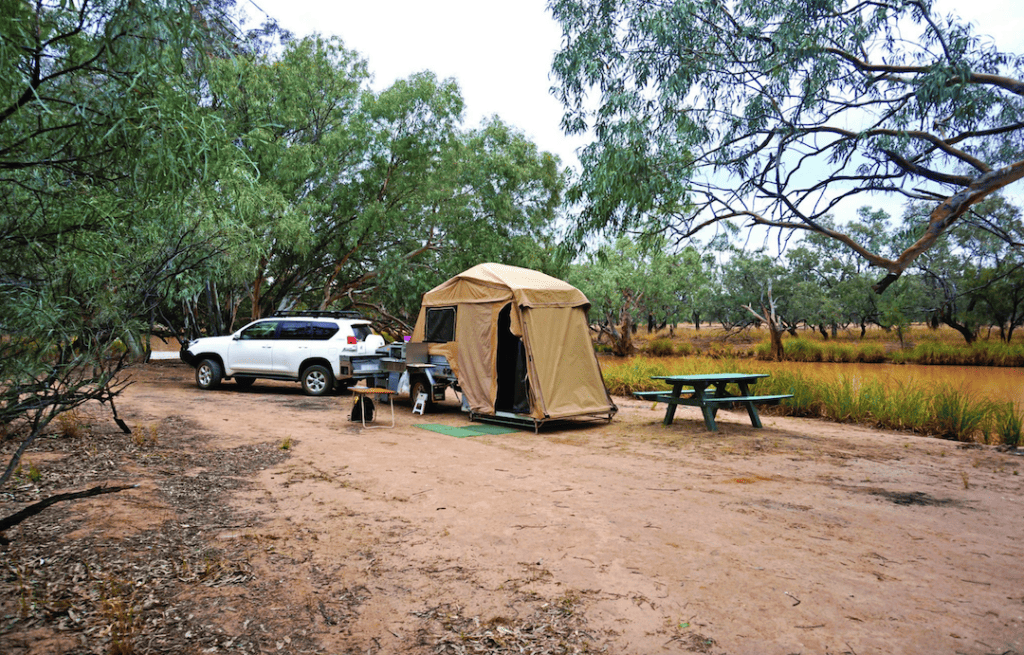
If you want to get away from the craziness of city life, or even busy town life, grab a rod and go fishing and camping near Thargomindah. The Bulloo River and surrounding waterways offer the chance to slow the pace right down, cast a line and settle into the rhythms of the outback. Fishing here is as much about the experience as the catch – sitting beside the water beneath an enormous sky, watching birds move through the river gums and waiting patiently for a bite.
For a bigger adventure, set aside a day for Currawinya National Park, on the traditional lands of the Budjiti people. The park combines Indigenous history, pastoral heritage and spectacular outback scenery. At Caiwarro Homestead, the remains of buildings, machinery and a levee bank shed provide a glimpse into life on a remote pastoral property during the 1800s.

There’s plenty more to explore, too, from wildlife and birdwatching to canoeing and kayaking. The park is home to a remarkable variety of plants and animals, including threatened species, making it well worth taking your time rather than simply ticking off the sights.
One of the highlights is the drive along the Granites track. Here, ancient rock formations rise dramatically from the surrounding landscape, their origins stretching back around 310 million years. Stay until late in the day and you’ll be rewarded with one of the region’s great spectacles: the outback sun sinking behind the red rocks.

It’s the simple things that make Queensland’s outback towns so enjoyable. Come for the history and stay for the fishing. Follow the heritage walk, search for wildflowers after rain, paddle a waterway, explore ancient rocks or simply pull up somewhere quiet and watch the sun go down. In Thargomindah, the stories are everywhere – in the mud bricks, the old river crossing, the rusted machinery, the ancient rocks and the waterways that have sustained life here for generations.
If you enjoyed this feature on Thargomindah, you might like to read our story on another historic Outback Queensland town – Cunnamulla.
Rex flies to Thargomindah and other regional Queensland destinations. Click HERE to book your flights and check out the route map below for more details.
