

When most people think of the Australian Outback, Uluru or the Kimberley most likely come to mind. However Broken Hill in Outback NSW has its own kind of magic. Dig beneath the surface and you’ll find a rich tapestry of history and culture, and a plethora of artists living and working in a place they love calling home.
The traditional owners of the Broken Hill area are the Wilyakali people, who are part of the broader Barkindji Nation. They have cared for the lands and region around Broken Hill and Silverton for over 50,000 years.
The red desert peppered with saltbush, dazzling blue skies and the open plains is a photographer’s dream, but it’s the people and the heart of the place that’ll make you want to linger longer in Broken Hill.

Broken Hill – the artback of Australia
Broken Hill has more than 20 art galleries to explore – some small and in the homes and backyards of residents, right up to the large Broken Hill City Art Gallery (BHAG). It opened in 1904, making it the oldest regional gallery in New South Wales.
The emporium – with impressive church-high ceilings – has a collection of more than 2,000 artworks, and an ever-evolving program of temporary exhibitions by local, state and national artists along with touring exhibitions. Every year the gallery hosts an annual acquisitive award called the Pro Hart Outback Art Prize, which is supported by the Hart family and has an awesome $23,000 prize pool.

Interestingly, the BHAG was originally owned by two well-known Broken Hill families – the Sullys (1885 – 1925) and the Sweetapples (1924 – 1985) and the emporium had stables and a blacksmiths in the backyard. Sully’s Emporium was essentially a hardware store that operated from 1885 until 1985, making it the longest surviving commercial business in Broken Hill.

A visit to Broken Hill is not complete without a visit to Pro Hart Gallery, which is the former gallery of one of Australia’s most prolific and eccentric artists – Pro Hart.
A largely self-taught artist, Hart developed a playful and imaginative style, depicting landscapes, people, animals, machinery and everyday Australian life, particularly in Outback Australia. He was also an inventor and sculptor, experimenting with unusual techniques and materials, such as placing paint-filled objects or containers on a canvas and detonating them.

Due to these methods that became synonymous with him, Pro shot to fame in a series of TV commercials for Stainmaster carpet cleaner. In the ads, Pro would pour red wine, cream, pasta and anything else he could throw on to his carpet, making a giant dragonfly piece of art.
His cleaner would then enter, shake her head and say: “Oh Mr Hart, what a mess!” And then she’d expertly clean it all up with Stainmaster. The dragonfly painting became on of his most famous works of art, and you can see many iterations of it in his preserved studio that’s surrounded by glass, within the gallery.

Inside the Silver City Mint & Art Centre in the middle of Broken Hill, you’ll find an extraordinary piece of art that took artist Peter ‘Ando’ Anderson many years and millions of brushstrokes to create. It’s aptly called Ando’s Big Picture, or he likes to call it an ‘Andorama’.
Visitors stand on a viewing deck in a gazebo-like structure to view the painting, which is 100 metres in circumference by 12 metres at its highest point. More than 300 tonnes of red dirt was laid and landscaped to match the artwork, so it’s hard to tell where the actual painting starts.
The detail is incredible, with Ando painting 100,000 salt bush plants, 20,000 trees, 20,000 small stones, 1,000 large stones, 3,000 clouds, 1,500 hills and the twelve sculptures that Broken Hill is famous for. In the first year after its completion, over 30,000 people visited it and has been going strong for 20 years as the region’s number one tourist attraction.

For more art that took years to create, head to The Palace Hotel, which was built in 1889 (originally as a coffee house) and shot to fame when scenes from Priscilla Queen of the Desert were filmed in the hotel’s front bar.
Inside on the walls, surrounding the main staircase, are the paintings of Indigenous artist Gordon Waye, who painted them over several years. Then the hotel’s former owner, Mario Celotto, painted a copy of Botticelli’s Venus on a ceiling.
You can stay at the hotel in one of 48 rooms, and even book the Priscilla Suite, which is somehow cool and garish at the same time, with a full mural on one wall, a chandelier and a black and hot pink bathroom complete with gold swan faucet above a claw-footed bath.

Mining, and the creation of Broken Hill
Due to a boundary rider named Charles Rasp discovering massive silver, lead and zinc deposits in Broken Hill, the ‘Silver City’ was founded in 1883, becoming the birthplace of mining giant BHP. It then evolved into being Australia’s first heritage-listed city, is renowned for pioneering strong labor rights.
Due to the harsh and dangerous mining conditions and toxic lead dust, miners formed associations that led to landmark victories such as a 35-hour underground work week and the lead bonus – a weekly cash allowance paid to local miners that fluctuated based on the international market price of lead.
From minor sums like a few shillings in the 1930s to more than £17 a week during peak commodity booms in the 1950s and much higher nominal amounts in later years, it boosted local wages and shaped Broken Hill’s economy.
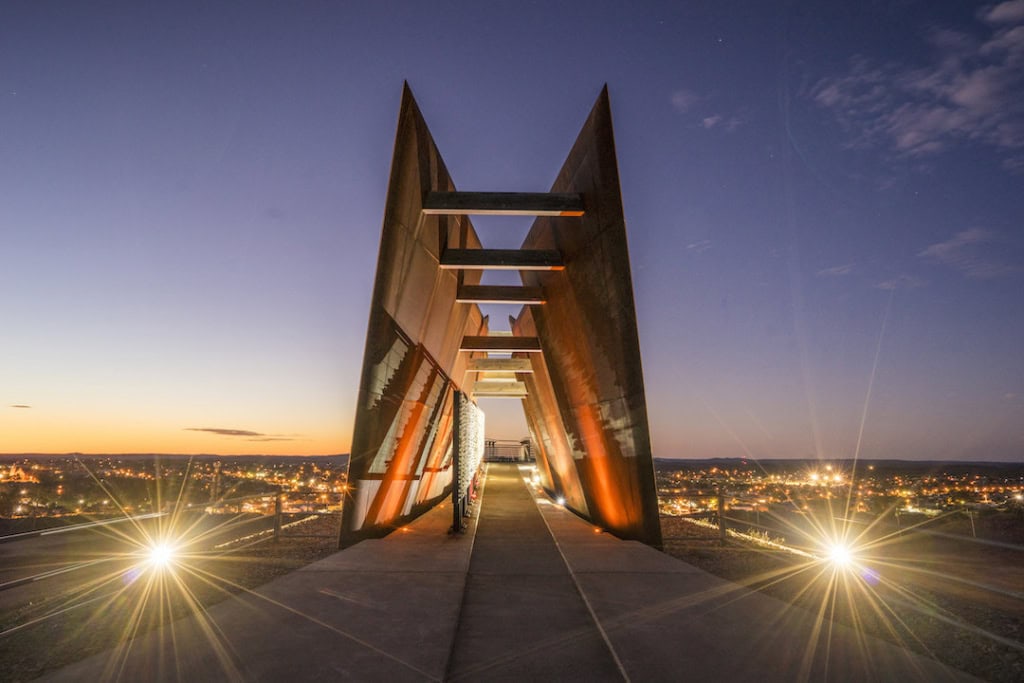
For a sobering look at just how tough the conditions were for miners, you can visit the Line of Lode Memorial in Broken Hill (pictured above) which is a beautifully designed memorial featuring the name of miners who have died since 1883, describing how they passed away.
You can learn a lot more about the mining history of Broken Hill at the quirky White’s Mineral Art and Mining Museum, which is a unique gallery and museum created by former miner Kevin “Bushy” White.
The museum features thousands of artworks that Bushy painstakingly created from crushed local minerals stuck to boards, depicting mining scenes, Australian animals and life in Broken Hill, alongside an enormous collection of rare mining memorabilia.

For more of Broken Hill’s mining history, step into the shoes of early miners at the Historic Daydream Mine, which is 28 kilometres northwest of Broken Hill near the tiny ghost town of Silverton.
Here you can walk the same tunnels where silver miners worked in the 1880s. Back then they worked by the light of candles held in wall-gripping candleholders called spiders, but these days it’s a lot brighter and safer, with electric lights and head torches for all visitors.
Silverton is also home to many galleries, which you can check out in this story on Broken Hill, Silverton and Wilcannia.

Looking into the universe from the red deserts of Broken Hill
One of the best things about outback towns is the lack of light pollution, which means great stargazing conditions. You can learn about our far-flung universe when joining an Outback Astronomy Experience on the outskirts of Broken Hill.
In the naturally dark, light-pollution-free environment that’s protected by local planning and court-backed lighting safeguards, guests can relax in a reclining chair while a guide uses a green laser to point out constellations, planets, star clusters, the Milky Way and other wonders of the Southern Hemisphere.

There’s a range of different experiences to choose from, such as the one-hour lunar session using maps, optics, and storytelling to explore Earth’s nearest neighbour that’s great for families, or for something more immersive, book a full evening experience with outback dining, drinks, and a guided astronomy tour.
If you enjoyed this feature on Broken Hill and want to learn more about Australia’s outback, you might want to read our story on Top things to do in Coober Pedy.
Travelling to Broken Hill
Rex flies to Broken Hill. Book your next adventure Here.
