

Tasmania’s West Coast is a region of rugged wilderness and the freshest air you can possibly imagine. It’s a place where heritage-listed rainforests are filled with wildlife, thriving rivers running through them.
When the warmer months arrive and the days become longer, enjoy cooling off in the crystal clear waters of waterfalls, explore historic sites and taste Tasmania’s produce, spirits and wine in some charmingly laidback pockets of the West Coast.

Take a train ride across Tasmania’s West Coast
The West Coast Wilderness Railway on Tasmania’s West Coast is a journey that lives up to its reputation and name by being a charming, historic train ride that makes you feel as though you’ve stepped back in time while witnessing true wilderness from the comfort of your cabin.
Running between Queenstown and Strahan through ancient temperate rainforest, the railway was built in the 1890s by Mount Lyell Mining and Railway Company using rack-and-pinion technology to conquer one of the world’s steepest sections of track, an engineering feat that holds its own today.

There are several journeys available all-year long, but spring and summer is when these remote destinations truly shine. On the Rinadeena, Rack and Rainforest experience, hop aboard a steam train at Queenstown Station, take a short break at Lynchford to try your hand at gold panning, then relax as you weave through the rainforest to Rinadeena Station for a chocolate tasting.
Step back in time in Queenstown
Queenstown is a historic copper mining town of less than 2,000 residents that was established in the late 1800s in a valley between Mount Lyell and Mount Owen. Sadly, it’s a picture of what happens when mining ravages the land with no regeneration plan. The surrounding hills are bare and wildly coloured, stripped of vegetation by over a century of mining smelter fumes and acid rain, leaving behind a landscape that looks eerily moon-like.

The Iron Blow Lookout is the site of the original 1883 mine and it offers sweeping views over the copper-streaked valley. Today it has a cantilever lookout platform for tourists to view the abandoned quarry.

Back in town, the Galley Museum is housed in the old Imperial Hotel, and tells the story of the West Coast’s wild mining past through photographs, memorabilia and minerals.
Also check out the 1933 Paragon Theatre – an art deco building with hand-painted floors that screens some of your favourite cinema classics. If you’re short on time, you can take a self-guided tour of the theatre and see the intact projection box, before watching a 15-minute short about the history of the site.

The Roaring Forties at Tasmania’s longest beach
Ocean Beach stretches for thirty-three kilometres along the West Coast, making it Tasmania’s longest beach. As you stand on the shore and look out at the horizon, remember that the next landfall is South America, twelve thousand kilometres away across the Southern Ocean.
The Roaring Forties arrive here with no warning and sometimes with no interruptions, often resulting in wild layers of surf and blazing red, pink and purple skies. Nearby, the Ocean Beach Trail is a manageable two-kilometre trail from Strahan that’s well-suited for walkers or cyclists.

Rising thirty metres behind Ocean Beach is Henty Sand Dunes – vast formations sculpted by the same wild, westerly winds, that are perfect for sand duning. Sandboards are available for hire from select businesses in Strahan and there’s a shaded picnnic area if you feel like a break and a cuppa. Note that there are no toilet or water facilities, so take a bottle of water with you.
Wild parks and wild rivers abound
In the heart of the Tasmanian Wilderness World Heritage Area (an hour from Strahan) Franklin-Gordon Wild Rivers National Park is home to cool-temperate rainforests, tall mountains and deep gorges. As the name suggests, it is fed by both the Franklin and Gordon Rivers, which offer plenty of opportunities for adventure, and relaxation amongst nature.
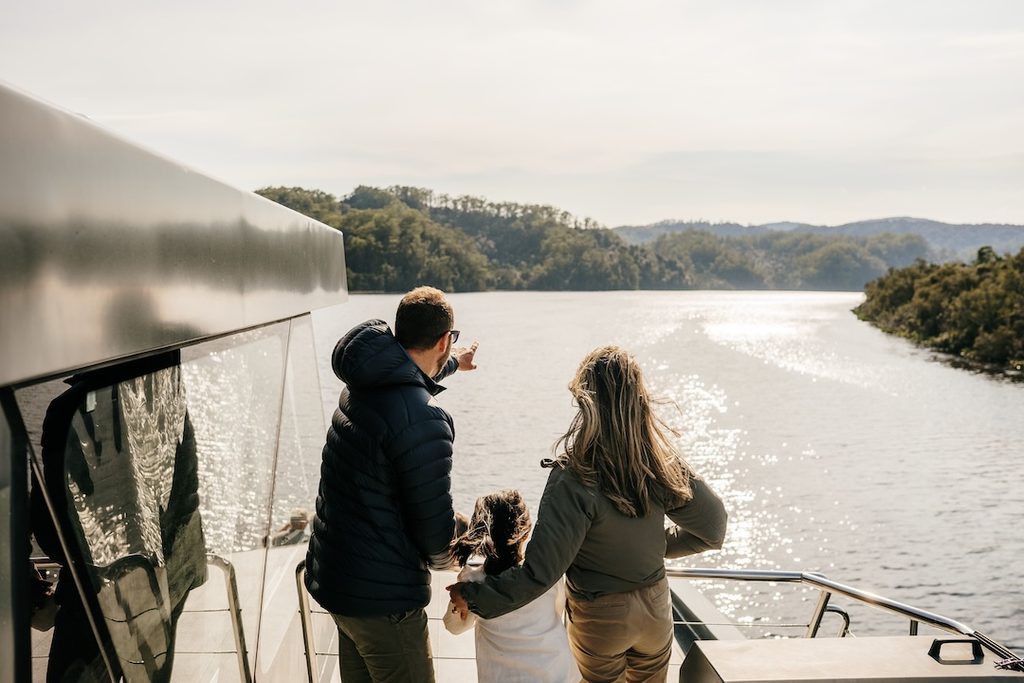
Stretching 172 kilometres and reaching depths of up to 570 metres, the Gordon River cuts through several World Heritage areas (including the Franklin-Gordon Wild Rivers National Park) and is one of the last great wild rivers on earth. Its waters are stained a deep brown with tannins from the buttongrass plains, so still and dark they create perfect mirror reflections of the Huon pines lining the banks.

There are several award-winning cruise operators who take visitors into the wilderness, including the immersive Gordon River Cruises. Departing from the main wharf in Strahan, the six hour journey takes you across the water as knowledgeable guides share the history of the surrounding landscapes, including Macquarie Harbour, Hells Gates, Heritage Landing and Sarah Island. There are also character-based interpretations to look forward to, where you’ll meet Captain James Kelly, Lady Jane Franklin and more.
Every ticket comes with a chef-prepared buffet lunch, while upgrading to the Upper Deck means you’ll enjoy complimentary local wines, beer, juice and coffee, premium leather recliners, and afternoon tea and canapes.

Adventurous adrenaline seekers can join a seven- to ten-day expedition with Water by Nature Tasmania. Journey through one of the last great wildernesses on Earth, and along the way, you might be lucky enough to spot a platypus in the eddies, a sea eagle soaring high above, and plenty of other incredible flora and fauna.
For those who’d rather stay on dry land, there are plenty of scenic walks through the national park. Named one of Tasmania’s best short walks, the Nelson Falls trail takes you to the end of a 700-metre boardwalk to look at the beautiful fanned falls as they pour into the rainforest, while Frenchman’s Cap is one of the most challenging hikes in the country, ending with a scramble to the summit of a giant mountain. It takes four or five days, but is well worth the trip for those out to conquer an exciting hike.

Tasting Tassie at its finest: wine, beer and whisky
After long days spent exploring the stunning natural wonders of the West Coast, why not relax with a locally-made spirit? Hellyers Road Distillery in Burnie is one of many great reasons to take your time getting back home. Established in 1997 by a group of dairy farming families who have worked the land since the 1950s, it is now Australia’s oldest continuously operating whisky distillery.
Here whiskies are shaped by the world’s purest air, verified by decades of independent measurement, and the particular coastal humidity that comes from sitting less than 20,000 kilometres downwind of Patagonia.

At the cellar door, enjoy a whisky flight and join the Whisky Walk Tour to go behind-the-scenes and learn all about the whisky-making process. You’ll even sample aged and rare whiskies directly from the cask.
Twenty minutes south of Ulverstone on Tasmania’s West Coast, on a north-facing hillside overlooking the Gunns Plains, Leven Valley Vineyard is a boutique producer of chardonnay and pinot noir wines, with its vines first planted in 1997.

The vineyard is a-top deep red and black clay loams over limestone, and at this latitude, it is one of the latest-ripening vineyards in Australia, a distinction that pushes intense cool-climate character into every bottle. The cellar door is run by Terri and Trenton Seager, who keep things unpretentious: bring your own nibbles, find a spot in the garden and taste the wines made from grapes picked by hand.
If you enjoyed this story on Tasmania’s West Coast, check out Tasmania’s best kept gourmet secrets HERE.
Rex flies to Tasmania. Book your flights here and check out the route map below for more details.
